Automated decisions at work: can you explain yours?
Take three decisions from yesterday's shift about who did what: a pick area, an overtime offer, a person moved off a task. For each one, try to answer a worker's question ("why me?" or "why not me?") from your records alone, in five minutes. If you can, you are ready for where the EU is heading. If you can't, this post shows you which record is missing and gives you a one-page sheet to start keeping it.
Why this question, now
The European Commission is preparing a Quality Jobs Act, and algorithmic management is expected to be one of its chapters. Warehouses are where the question is being asked first: on 26 and 27 October, members of the European Parliament's employment committee were due to visit Amazon warehouses in Dortmund, Mönchengladbach and near Katowice, to look at how work is organised, how productivity is measured and how automated systems are used, EU Today reported.
The law itself doesn't exist yet. The Commission's second-phase consultation names "making automated decisions more transparent and human-centred, and protecting employees from excessive monitoring" as one of its aims. Executive Vice-President Roxana Mînzatu told EU Perspectives she hoped the Commission would adopt the proposal on 3 December, and said: "Workers need to know how they can appeal that decision taken by an algorithm if they don't agree with it."
None of that is law today, and the final text may look quite different. But the direction is clear, and it doesn't stop at Amazon. In the Commission's own Flash Eurobarometer of SMEs and mid-caps, 42% of companies already use AI or algorithmic management, and logistics, planning and staff scheduling is one of the commonest uses, at 30%. Almost half (49%) said they don't trust automated systems with decisions about staff. If your warehouse system, rota software or a spreadsheet macro decides who picks where or who is offered a shift, the question applies to you.
What GDPR already says about automated decision-making
Two articles of the GDPR already cover some of this, in every EU country. This is a summary of the text, not legal advice; your own adviser decides how it applies to your site.
- Article 22 gives a person the right not to be subject to a decision based solely on automated processing that has legal effects on them or similarly significantly affects them. Where such a decision is allowed, the employer must offer at least the right to obtain human intervention, to express their point of view and to contest the decision.
- Article 15(1)(h) lets a person ask whether such automated decision-making takes place and, if it does, to receive meaningful information about the logic involved and what it means for them.
Most allocation on a warehouse floor has a person somewhere in it, so whether Article 22 bites on a particular decision is a question for your adviser. The practical point holds either way: if a worker asks why, someone has to be able to answer.
The test: three decisions, five questions
Pick three decisions from yesterday where the worker could reasonably mind the outcome. For each, write one line in answer to each question:
- What was decided? In plain words, with the time.
- What was it based on? The rule, and the facts about this person that the rule used.
- Who else could have got it, and why didn't they?
- Who could have changed it, and did anyone look?
- How does the worker challenge it, and who answers?
Time yourself. Answers from memory don't count; they must come from a record someone else could also open.
A worked example: three decisions at a chilled depot
The decisions below are illustrative, the kind a chilled distribution depot makes every night. The gaps are typical, not findings from a real site.
| The decision | What the worker asks | The record that answers it | The usual gap |
|---|---|---|---|
| A picker is put in the freezer for the third night running | "Why me again?" | Who was eligible for freezer picking last night, and the rotation rule | The warehouse system assigns by zone and keeps no record of who else was eligible |
| Overtime on Saturday goes to four people, not the one who asked first | "I put my name down. Why not me?" | The order the offer went out in, and why each person was or wasn't asked | The offer went out by phone from the team lead's list; there is no record of who was rung |
| A driver is taken off reach-truck work mid-shift | "What did I do wrong?" | Whether the licence or refresher date was the reason, and who made the call | The licence register is a separate spreadsheet; the decision was verbal |
In each case the decision may have been perfectly sound. The problem is that nobody can show it. "The system did it" is the answer workers trust least, and it is exactly the answer the Commission's consultation is aimed at.
How a challenge should run
When a worker asks why, the first answer should come from the record, not from someone's memory, and the next step should be a named person, not "the system".
flowchart LR
  Q[Worker asks why] --> R[Shift lead answers from the record]
  R -->|satisfied| D[Logged, closed]
  R -->|not satisfied| H[Named reviewer looks again]
  H --> C{Change it?}
  C -->|yes| F[Corrected, worker told, rule checked]
  C -->|no| E[Reason given in writing]
  F --> D
  E --> D
Two things make this work. The shift lead has the record in front of them, so the first answer takes minutes. And the reviewer is a person with the authority to reverse the decision, named in advance, not found after the complaint arrives.
Copy the allocation record
Keep one row per decision that someone could mind: freezer or ambient, overtime, a cover offer, taking someone off a task. Routine moves that nobody minds can stay out.
| Column | What goes in it |
|---|---|
| Date and time | When the decision was made |
| Decision | Plain words: "freezer picking, 10pm–6am" |
| Who got it | The person, or the role for a team |
| Rule used | The written rule, such as "rotate freezer nightly, nobody more than two nights running" |
| Who else was eligible | Names, and why each didn't get it ("two nights already", "licence lapsed") |
| Decided by | System, person, or system then confirmed by a person |
| Reviewed by | Who looked, if anyone |
| Challenged? | Yes or no, and the outcome |
Fill it by hand for one week. The columns you can't fill tell you where your process has no memory.
Where Fivexer fits, and where it stops
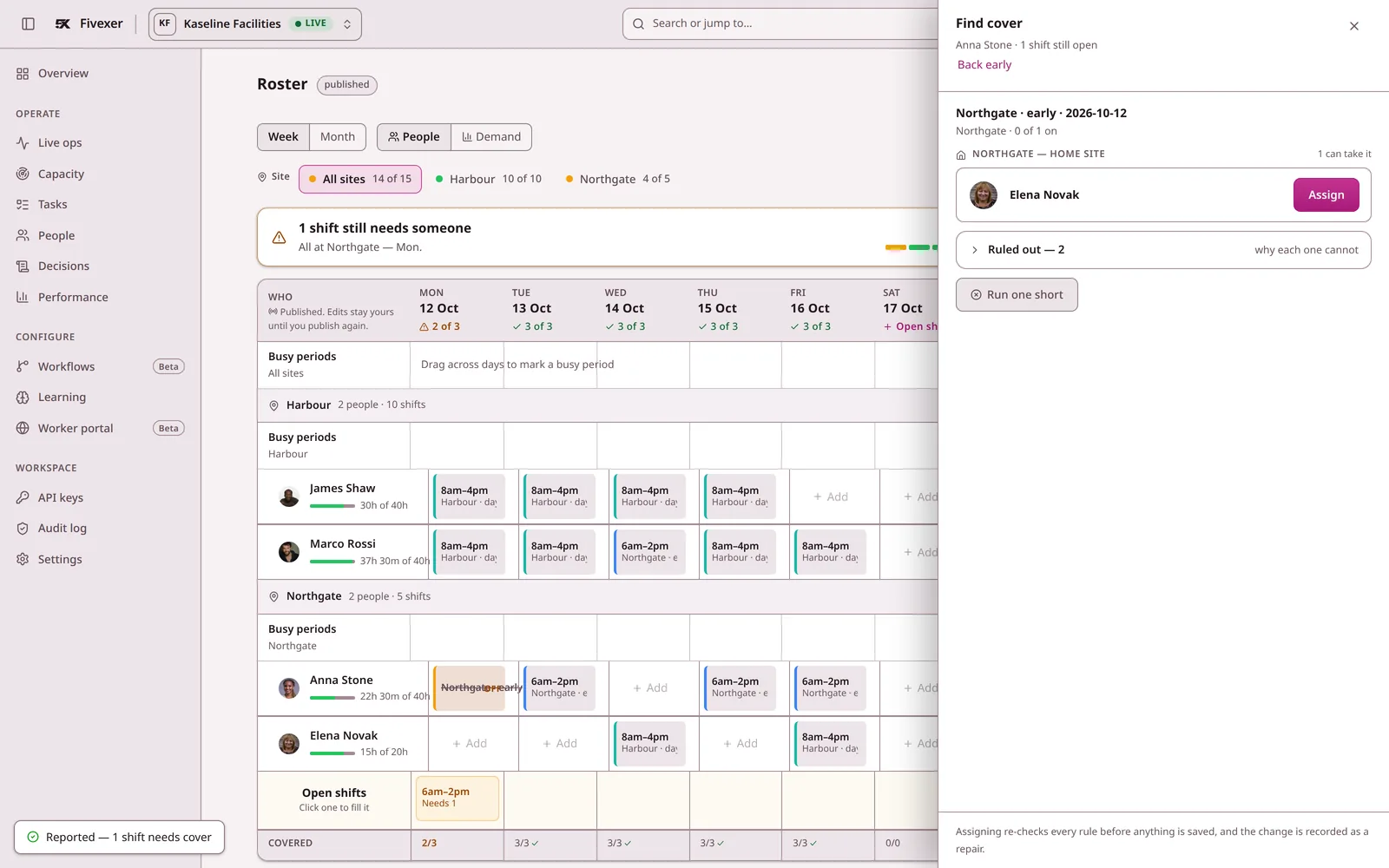
For shift cover, Fivexer keeps the "who else was eligible" column for you: when someone calls in sick, shift cover ranks the qualified, rested replacements and records why every other worker could not take the shift. That is the kind of record the test above asks for.
The same goes for routed tasks. Each decision keeps the full list of who was considered: who got it, who else was eligible, and who was excluded and why.
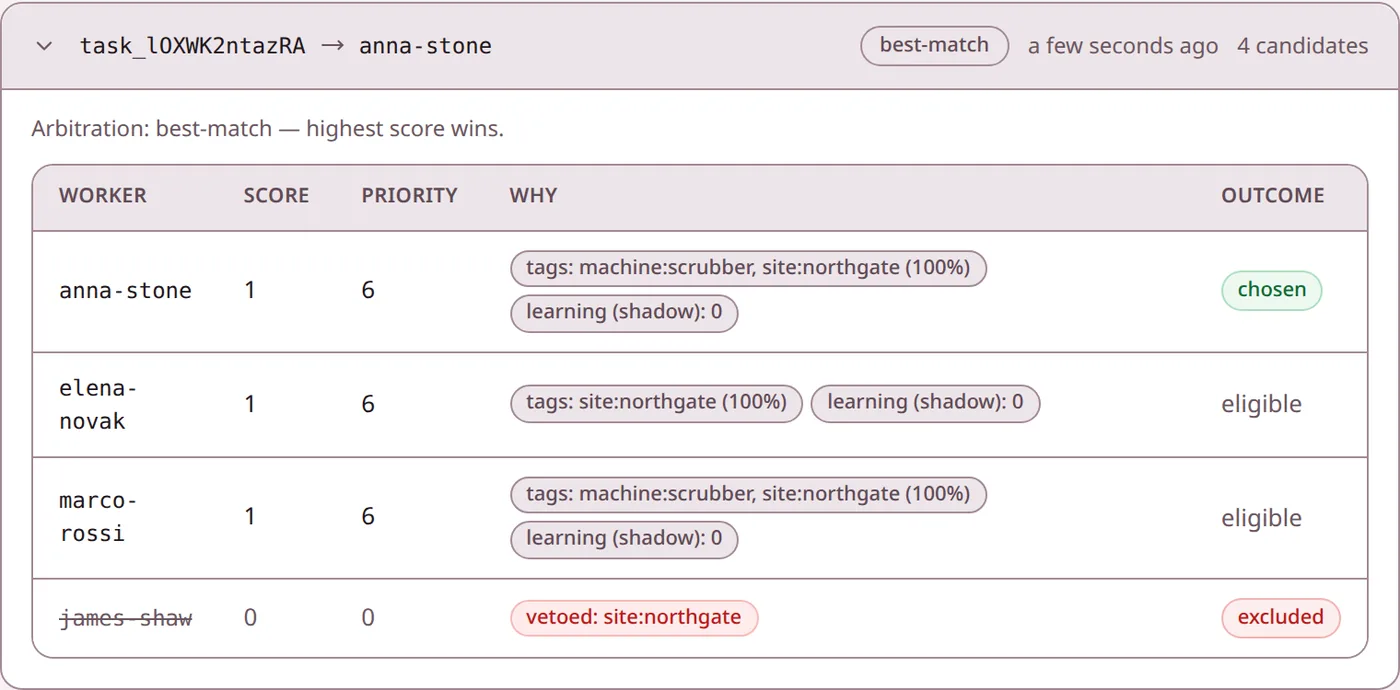
It can only explain decisions it made. Anything your warehouse management system assigns, or a team lead arranges by phone, stays outside it, and you will still need the sheet for those. It also doesn't judge whether your rules are fair. Fivexer checks the rules you configure; whether "nobody more than two nights running in the freezer" is the right rule is for you, your staff and their representatives to agree.
Run the test tomorrow
Pick three of tomorrow's allocations, answer the five questions from the record, and time it. Start the one-page record for whatever you couldn't answer. For cover decisions, see how shift cover records why each worker was or wasn't asked.