Human-AI collaboration needs someone on shift
In a service business, human-AI collaboration is mostly handoffs: an AI agent reads, looks up or drafts something, then passes the job to a person who is certified, authorised or accountable for the next step. The agent works at two in the morning. The engineer, the person who approves the spend and the person who signs off the report are on a rota the agent knows nothing about. So the job runs quickly up to the first step that needs a person, then waits there.
This post gives you a handoff map for one job type: each step, whether an agent or a person does it, what the person must hold, who is actually on when the step arrives, and what happens if nobody takes it. It ends with four tests to run before the first live job.

Every human-AI handoff needs three answers
When work passes from an agent to a person, or back, three things decide whether it keeps moving:
- Who may receive it. Not "a person" but a person holding something specific: a certificate, a sign-off, authority to approve spend.
- When they're on. The rota, the on-call list and the gaps between them. A step that lands at 3am with nobody on until 8am waits five hours, however quickly the agent finished.
- What happens if nobody takes it. A backup, a deadline, and someone whose job it is to notice.
The first answer is the one people think of when they design the workflow. The other two are rota questions, so bring whoever keeps the rota and the on-call list into the room when the workflow is designed.
A worked example: the cold store running warm
The example is illustrative: a refrigeration contractor gets a fault report from a customer's cold store in the middle of the night. The store is reading −12°C against a −22°C set point.
Some steps suit an agent: reading the report and photos, finding a part, drafting the customer's job report. Some must be a person. In the EU, Regulation (EU) 2024/573, Article 10 requires the people who install, service or repair stationary refrigeration equipment to be certified, and the certificate types are set by Implementing Regulation (EU) 2024/2215: an A1 certificate covers any charge size, an A2 only equipment holding less than 3 kg. A cold-store unit holding 3 kg or more of refrigerant needs an A1 holder. Great Britain has its own F-gas rules. Saying yes to spend above an engineer's limit is a person's call too.
Here is the job as a handoff map, with the times the steps would arrive when the report comes in at 2am. Response windows are examples; set your own.
| Step, done by, must hold | Arrives, and who's on then | If nobody takes it, and what it costs |
|---|---|---|
| 1. Read the fault report and photos · Intake agent · nothing | 2am · the agent | Page the on-call engineer directly |
| 2. Attend the condensing unit · Person · F-gas A1 certificate | Just after 2am · on-call A1 engineer | Backup on-call A1 engineer after 30 minutes |
| 3. Find a fan motor that can be collected tonight · Parts agent · nothing | About 3am · the agent | Engineer rings the supplier |
| 4. Approve the part above the engineer's spend limit · Person · spend approval | About 3am · nobody until 8am | The store keeps warming |
| 5. Write the customer's job report · Report agent · nothing | About 4am · the agent | Can wait |
| 6. Review the report before it goes out · Person · report sign-off | About 4am · nobody until 8am | Waits for the day; nothing lost |
Two person steps wait until 8am, and they aren't equal. The report can sit until the day starts without costing anything. The approval can't: for five hours an engineer stands next to a failed unit with a part available across town and nobody allowed to say yes, while the customer's stock warms. Nobody decided to leave spend approval uncovered overnight. The rota just doesn't cover it.
So rank your handoffs by what waiting costs, and cover the expensive ones on purpose: raise the on-call engineer's overnight spend limit, or put someone with approval authority on the on-call rota. The cheap ones can wait for the morning, and the customer can be told so.
What the record shows
Here is the same job run in Fivexer on a demo workspace, with agents and people on one team. An AI agent split the job into steps and noted why it sent each one where it did. The demo runs in under a minute, so the times on screen are compressed; on a real night the gap above would show.
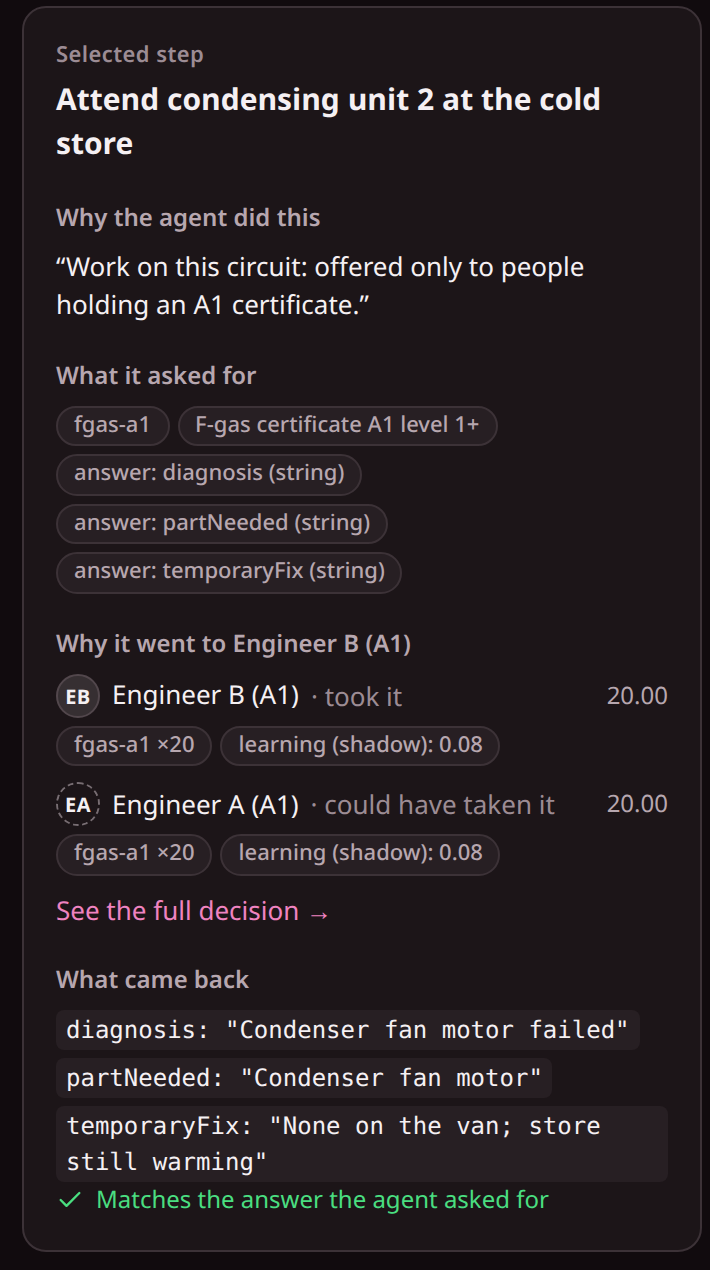
The attend step went only to the two engineers holding an A1 certificate. The third engineer on the same team holds only an A2 and was never in the running. Both A1 holders scored the same, so either could have taken it; the record names the other one as able to, which is who you'd ring if the first declined.
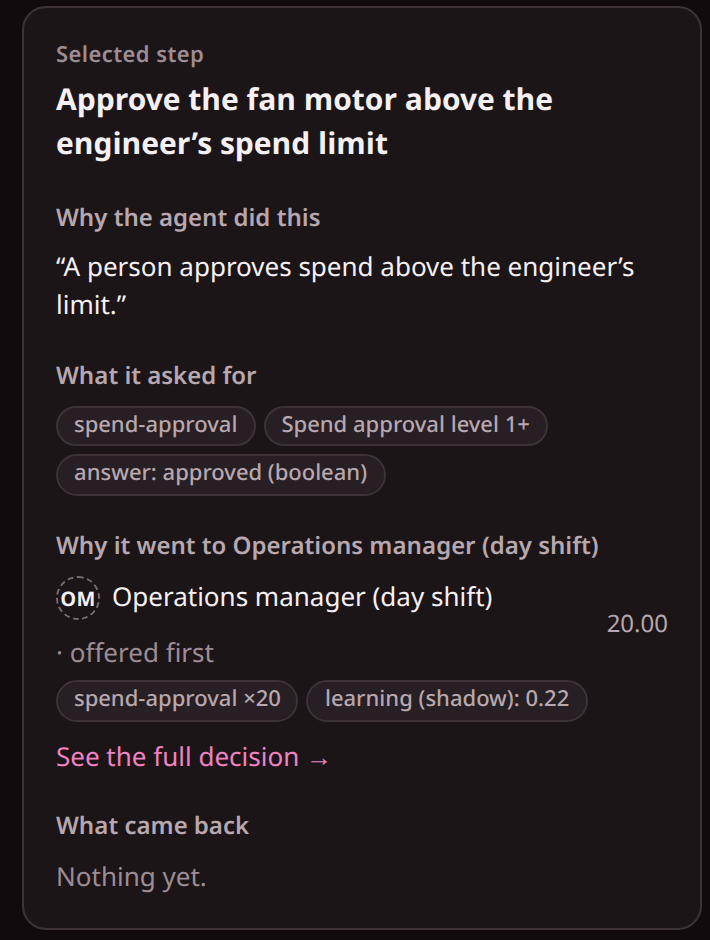
The job is still running, and the approval is offered to the operations manager on the day shift. That's the honest state at 3am: the engineer's diagnosis and the part are on record, and the step that unblocks the store is waiting for someone who isn't on.
Copy the handoff map
Fill one sheet per job type. Start with the job you'd most like an agent to help with, and fill it for your worst hour: overnight, a bank holiday, the week your most qualified person is on leave. Give the spreadsheet these eight columns, one row per step:
- Step: what has to happen, in a few words.
- Done by: agent or person.
- Must hold: the certificate, sign-off or authority a person needs. "Nothing" for most agent steps.
- Arrives (worst hour): when the step would land.
- Who's on then: by role, from the rota and on-call list.
- Cost of waiting: what goes wrong for each hour nobody takes it.
- If nobody takes it: the backup, and after how long.
- Who notices: a person, by role.
Two of those columns do most of the work. Cost of waiting tells you which gaps to staff and which to explain to the customer. Who notices must be a person, by role: "the system alerts" isn't an answer unless someone is on to read the alert.
Four tests before the first live job
Run each one on a test job, with the real rota and on-call list in front of you:
- Send the job at the worst hour. Does every expensive person step land on someone who is actually on?
- Take the certified person out. Mark them on leave and send a job that needs the certificate. It should go to the next certified person or wait visibly, and never to someone without it.
- Make the agent return something wrong or incomplete. The next person should get it with enough context to catch it, and the record should show what the agent actually returned.
- Have the person decline. The step should go to the backup within your window, and the deadline should still count from when the job arrived, not from the decline.
If a test fails, fix the map before the first real call-out.
Where Fivexer fits, and where it stops
Fivexer routes each step to an eligible agent or person, checks the certificate or authority you've recorded, and keeps a record of who was offered the work and why. The trade side, from certificates to on-call, is on the trade contractors page.
It has limits you should plan around. Your rota and your job routing share one list of people, but routing doesn't read the rota yet: Fivexer offers an immediate step to anyone signed in and available, including someone on approved leave. Keep the "who's on then" column yourself, and run test 2. A certificate past its expiry date keeps routing until the person's record is saved again, so keep expiry dates current. Fivexer doesn't run or judge your agent either: whether the job report is any good is still a person's call, which is why step 6 exists, and the record explains the routing, not the agent's reasoning. For designing the queue an agent hands cases to, see your AI service is decided at the human handoff.
Map one job this week
Pick the job type you'd most like an agent to take on, fill the handoff map for your worst hour, and run the four tests. When every expensive person step has someone on, see how Fivexer puts agents and people in one queue.