Tribal knowledge is why your rota won't automate
Ask whoever builds your rota why a particular person is on Tuesday's late. The answer comes in seconds: one of only two people signed off on the allergen changeover; can't do an early after a late; never on the same line as a particular colleague. Then ask where those rules are written down. Often they aren't.
That is tribal knowledge: know-how that lives in people's heads instead of in a record anyone else can read. On a production site it decides who works tonight, and it's why an automated rota can disappoint, whether the tool calls itself AI or not. A tool can only follow the rules it's given. Give it half of them and it drafts a week that breaks the other half, the planner fixes the week by hand, and before long the planner is doing the whole rota by hand again.
Below is a one-hour interview that gets the rules out of the planner's head, a rulebook sheet to write them into, and a test against last month's rota that tells you whether you got them all. None of it needs software.

A factory scheduler on Hacker News described where this ended up for them. They built the training rota in Excel. Some constraints the business wanted, like training on one machine before another, were too hard to make configurable, so the sheet got a notes section instead: "they have to manually observe these constraints." That notes column is tribal knowledge with a cell reference.
Four places a rota rule comes from
Every rule your planner applies comes from one of four places, and the rulebook below keeps them apart:
- the law: rest between shifts, a day off each week, average weekly hours;
- an agreement: contracted hours, availability someone agreed to, a collective agreement;
- the site: training records, licences, minimum crewing on a line, a food safety procedure;
- custom: who works well together, who gets the Saturdays.
From the outside, a placement driven by the law looks exactly like one driven by custom. A rota tool can't tell them apart, and neither can the person covering the planner's holiday. The difference matters, because a legal rule can't be traded away and a custom often can.
How to capture tribal knowledge from your planner in an hour
Book an hour with the planner and bring two printed rotas: a normal week and a week that went badly. Then:
- Go shift by shift. For every name ask "why this person here?", and for every gap or near-miss ask "who couldn't go here, and why not?" The second question finds the rules. The first mostly finds preferences.
- Write each answer as a sentence in the planner's own words. "Never a late then an early." "Always a forklift driver on." Don't sort or tidy yet; the wording you get is the wording the planner will recognise later.
- Ask where the rules came from. What did you change after the last audit, complaint or near miss? Who do you always need on, and who do you never put together? What did the last holiday cover get wrong?
- Stop at an hour. Expect a page of sentences. If you get fewer than ten, the rotas you brought were too easy; repeat with the bad week.
Sort every sentence into the rulebook
Now turn each sentence into a row. The sheet has one job: make every rule something a second person can check against a rota without asking the planner.
The rows below are an illustrative example for a food packing site in Ireland running a 6am–2pm early and a 2pm–10pm late. The law rows cite Ireland's Organisation of Working Time Act 1997. In your own spreadsheet, give the planner's words, the rule, the type, the source and the owner a column each, and add a blank column for your site's number where it differs.
| Planner's words, then the rule as a check | Type, source, owner |
|---|---|
| "Never a late then an early" At least 11 consecutive hours between the end of one shift and the start of the next | Hard · Law: Working Time Act, s.11 · HR |
| "Everyone gets a proper day off" At least 24 consecutive hours off in each 7 days, straight after a daily rest | Hard · Law: same Act, s.13 · HR |
| "Nobody over 48" An average of no more than 48 hours a week over a reference period of up to 4 months | Hard · Law: same Act, s.15 · HR |
| "Always a forklift driver on" At least 1 person with a valid forklift licence on every shift | Hard · Site safety procedure · Warehouse lead |
| "Two signed off on changeover" At least 2 people trained on allergen changeover on any shift that has one | Hard · Site training records · QA manager |
| "New starters on earlies first" New starters work earlies only for their first 5 shifts | Hard · Site induction policy · Production manager |
| "Students only at weekends" Named people available Saturday and Sunday only | Hard · Agreed availability · Planner |
| "Keep those two apart" Ask why before writing anything | Find out · Unknown · Production manager |
| "Fair share of Saturdays" Nobody works more than 2 of any 4 Saturdays | Preference · Custom · Production manager |
Three rules decide what goes in each column.
A hard rule needs a number and an owner. "Enough rest" can't be checked; "11 consecutive hours" can. If nobody will put their name in the owner column, the rule isn't hard yet.
Check the planner's version against the source. If the planner's "nobody over 48" means 48 in any single week, that's stricter than the Act's average over up to four months. Being stricter is allowed; decide on purpose which one you mean, because a tool will apply whichever number you give it.
Ask what breaks if the rule is broken. "Keep those two apart" might be a safety concern, an HR matter that HR should own, or a clash that ended years ago. If nobody can say what would go wrong, it's a preference at most, and some rules turn out to be custom that can go.
Test the rulebook on last month's rota
A rulebook is finished when it explains the rota the planner actually ran. Take the last four weeks as worked, not as first published, and go through them with the sheet.
You are looking for two things:
- A rule broken often with no consequence. It's a preference, or it isn't real. Move it, or delete it.
- A placement no written rule explains. That's a rule still in the planner's head. Go back and ask.
The rest rules are the quickest to check by hand. Sort each person's shifts by start time and work out each gap. With the example shifts, a 2pm–10pm late followed by a 6am–2pm early leaves 8 hours, which fails an 11-hour rule; a late followed by another late leaves 16 hours, which passes. Remember the first shift after the period: a Sunday late and a Monday early sit in different weeks, and each week can look fine on its own. The rest-break checker does the same arithmetic for one person's week at a time, including the shift before it, and takes shifts pasted from a spreadsheet.
When four weeks go by with no unexplained placements, the rulebook is complete enough to hand to someone else.
What a written site rule shows you
Here is part of that rulebook in Fivexer, on a demo workspace for a food packer. The legal rows are the easy part: the working-time rules started from Ireland's figures, and the screen names the sections of the Act they came from and when they were checked.
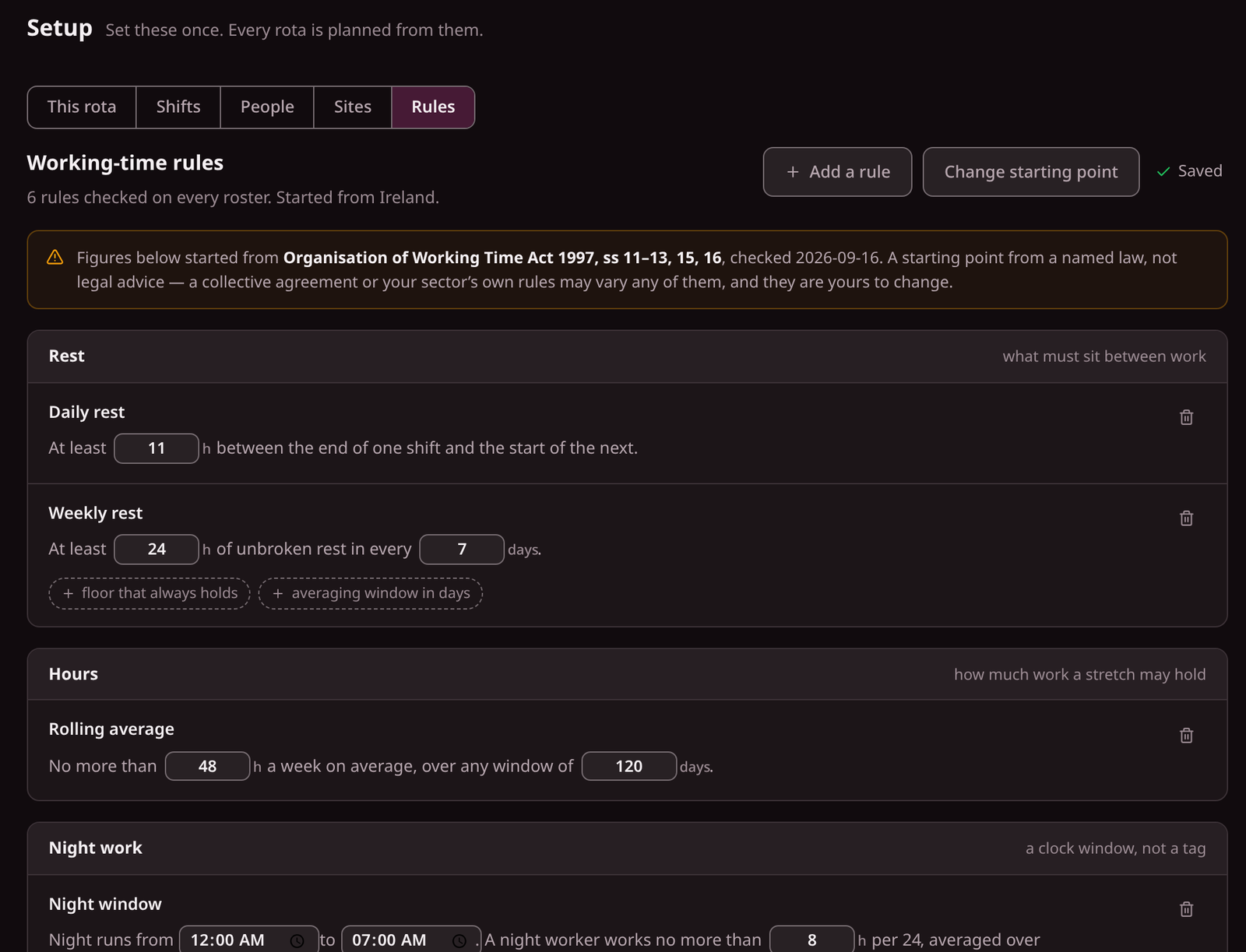
The site rows are the ones the interview exists for, and they're where a written rule pays off. In the same demo, "always a forklift driver on" is entered as one forklift-licence holder on every shift, and three of the ten people hold the licence. The planned week then shows the kind of gap that otherwise gets patched by phone: on Sunday, neither shift has a licence holder.
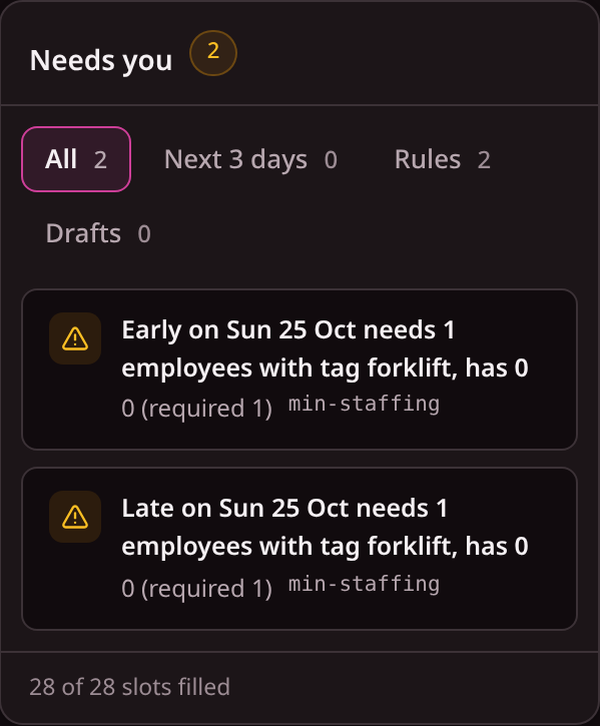
The gap exists whether or not the rule is written down. Written down, it shows up while the week is still a draft, and the fix is a decision you can make on Thursday instead of a phone call on Sunday morning: agree who comes in on Sunday, and put a fourth driver on the training plan.
Where this stops
Not everything becomes a rule. "They've had a hard month, keep them off nights for now" is a judgement, and it should stay one. Record it as a manager's decision with a date, not as a permanent rule nobody remembers adding.
One gap in the tool matters on a bad morning. When we tested a sick call on the only forklift holder on a shift, Fivexer's cover list offered people without the licence. The missing licence appeared only as a warning after someone was assigned. Read the warnings before you confirm a cover change.
Rota planning in Fivexer checks rest and hours, the number of people holding a skill on each shift, and licence expiry dates. "New starters on earlies first" and "keep those two apart" aren't built-in rules; keep those rows on your sheet and check them by hand.
The Irish starting point checks the 24-hour weekly rest and the 11-hour daily rest as two separate rules, while the Act wants the weekly rest to follow a daily rest directly, which makes 35 hours in one stretch by default. Treat every figure as a starting point: a collective agreement or your sector's rules can change it, and none of this is legal advice.
Book the hour
Put an hour in the diary with your planner this week, print last week's rota and a bad week, and fill the rulebook. When four weeks of worked rotas pass the test, enter the rules Fivexer can check (rest, hours, people with a skill on each shift, licence expiry) as scheduling rules, and keep the rest on the sheet.