AI readiness assessment: five checks for shift sites
On a site that runs on shifts, a useful AI readiness assessment is five checks you can run on last month's records in an afternoon. Each check matches one of the reasons AI for rotas, cover and work allocation stalls on a production floor, in a depot or in a field service office: rules nobody wrote down, training records that don't match who works, sick calls that live in a group chat, decisions nobody can explain, and problems at 6am that nobody owns. Score the five and you'll know where AI can help now, what to fix first, and what to ask a vendor.
Most readiness assessments score data platforms, cloud set-up and AI skills. That fits head office. On a site that lives on a rota, AI stalls for more ordinary reasons. Often the business can't see what AI would do for it: when the UK government asked 3,500 businesses what stops them adopting AI, the answer given most was a lack of identified need (71%, DSIT AI adoption research, fieldwork February to May 2025). The checks below give a shift site that answer: each pass points to a job worth trialling, listed under "Reading your score".

The AI readiness scorecard
Run each check on last month's records, not on how things are supposed to work, and mark it pass or fail. If you're unsure, it's a fail. Copy the table into a spreadsheet and add a column for your result.
| Check | How to test it, and what a pass looks like | Ask the vendor |
|---|---|---|
| 1. The rota rules are written down | Someone other than the planner lists the hard rules with numbers and owners. Pass: one rulebook that explains four worked weeks. | "Where do our rules go in, and what happens to a rule you don't support?" |
| 2. Training records match who worked | Pick ten random shifts; find each person's record for the work they did. Pass: ten out of ten, without asking anyone. | "What happens on the rota when a licence expires next Tuesday?" |
| 3. Absences are on record | List last month's short-notice absences with time reported and who covered. Pass: all of them, in one place. | "When someone rings in sick before six, where is that recorded and who sees it?" |
| 4. One decision can be explained | Pick one shift from last week; write why that person got it and two others didn't. Pass: five minutes, from records only. | "Show me why the second-best person didn't get this shift." |
| 5. Every exception has an owner | Name who handles a sick call before the first shift, on all seven days, and their backup. Pass: seven named roles and a backup. | "When nobody can cover, who is told, and by when?" |
The vendor questions matter as much as your score. A tool that can't answer one of them will push that problem back onto your planner.
Why each one stops AI
1. Rules in one person's head
When the rules live in the planner's head, a scheduling tool drafts a week the planner has to fix by hand, and the planner stops trusting it. Getting the rules out takes about an hour with the planner and a printed rota; the method is in our post on capturing tribal knowledge for rota rules.
2. Records that don't match the floor
A tool that allocates work treats the training record as the truth. If the matrix says someone isn't signed off, the tool won't put them on, however often they've actually done the work. If it says someone is signed off after the sign-off has lapsed, the tool will put them on unless the record carries an expiry date. Our post on the training matrix as a rota problem covers keeping the two aligned.
3. Sick calls that live in a group chat
Short-notice cover depends on knowing who's off, who's free and who's already worked too many hours. If absences arrive as texts to a supervisor's phone, any tool sees a full rota and a person who didn't turn up. Fix it with one place where every absence goes, whoever takes the call.
4. Decisions nobody can explain
Sooner or later someone asks why they keep getting Saturdays, or why the overtime went to somebody else. Distrust is common: in the European Commission's spring 2026 survey of about 12,800 heads of EU firms with up to 749 staff, 49% said they don't trust AI or automated systems for decisions about staff (Flash Eurobarometer, 14 October 2026). The law treats these decisions as sensitive too. The EU AI Act lists AI systems used to allocate tasks based on individual behaviour or personal traits among its high-risk uses (Regulation (EU) 2024/1689, Annex III, point 4(b)); whether a particular scheduling tool falls under it is a question for the vendor and your adviser. Our post on algorithmic management your floor will accept covers what that means on a floor.
Here's check 4 passing on a real screen, recorded on a Fivexer demo workspace for a food packer. A person on Monday's late is reported off sick; the cover list shows the one person who can take the shift and the six who can't, each with the reason.
5. Problems at 6am that nobody owns
Automation can list who is free and within the rest and hours rules straight away. Somebody still has to accept the change, or decide what happens when nobody suitable is free, and that person has to be awake and on duty. An AI agent that hands work back to people meets the same gap: the step reaches someone nobody rostered to receive it. Our post on human-AI collaboration and handoffs maps it step by step.
The useful version of this check is a deadline. In a second demo, every shift needs one person trained on allergen changeover and four of the ten are trained. The rota marks six shifts in the next three days as one sick call away from having nobody trained, the nearest ones marked act now.
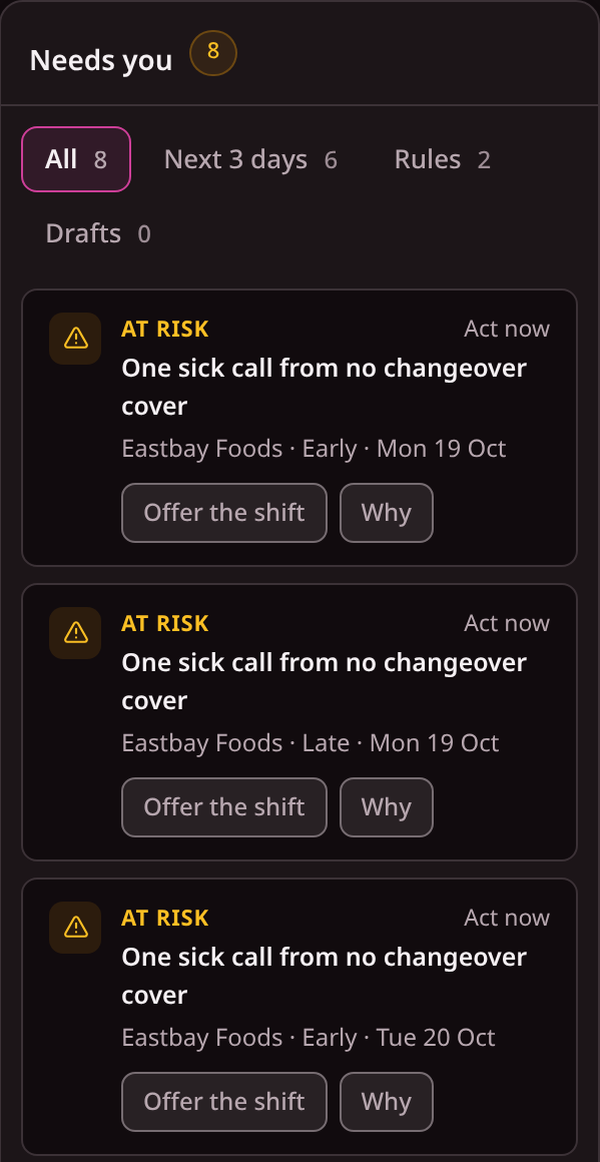
A warning with a deadline only helps if check 5 names who reads it on Monday morning.
Reading your score
Fix failures in the order 1, 2, 5, 3, 4. Rules and records are what any tool runs on. Owning exceptions takes one conversation. Absence records and explanations get easier once the first three are in place.
Then start AI where you pass:
- Checks 1 and 2 pass: trial drafting next month's rota against the written rules, with the planner approving it.
- Checks 1, 2, 3 and 5 pass: trial automatic cover for sick calls on one team.
- Check 1 fails: don't buy a scheduling tool yet, however good the demo looks. Write the rulebook first.
Where this assessment stops
The five checks cover rotas, cover and allocating work to people. They don't assess demand forecasting, machine scheduling, maintenance prediction or quality inspection, which have their own data needs. A pass doesn't mean a tool will pay for itself; it means it won't fail for the ordinary reasons above.
On our side, here are Fivexer's answers to the five vendor questions. Rules it doesn't support, such as "new starters on earlies first", stay on your sheet as manual checks. On the rota, an expired licence stops the person being planned, but in live job routing an expired skill keeps routing until the person's record is saved again. Absences reported in the console sit on the rota where the planner sees them. The cover list explains rest and hours exclusions person by person; a missing licence shows only as a warning after someone is assigned. Warnings like the one above carry a deadline, but someone you name still has to read them. Fivexer can't tell you whether your training matrix is accurate, and it doesn't give legal advice on what your rules should be.
Start with your first fail
Book an afternoon, pull last month's rota, training records and absence notes, and fill the scorecard. If check 1 failed, the one-hour planner interview in our tribal knowledge post is the fix, and the rules it produces go into scheduling rules.