For restaurants, cafés and hospitality groups comparing Heybegin
A Heybegin alternative that builds the rota for you
Heybegin schedules from templates. Fivexer builds the week under the rules you set. It ranks cover when someone calls in sick. It keeps the reason for every pick.
- €0.50 a person, past the first 15
- Every site, on every plan
- Overtime and availability, working today

Test the same absence before switching
Use this evaluation scenario in both products: 40 workers, five client sites, recurring shifts, site permissions and one same-day absence. These are trial assumptions, not a benchmark or customer result.
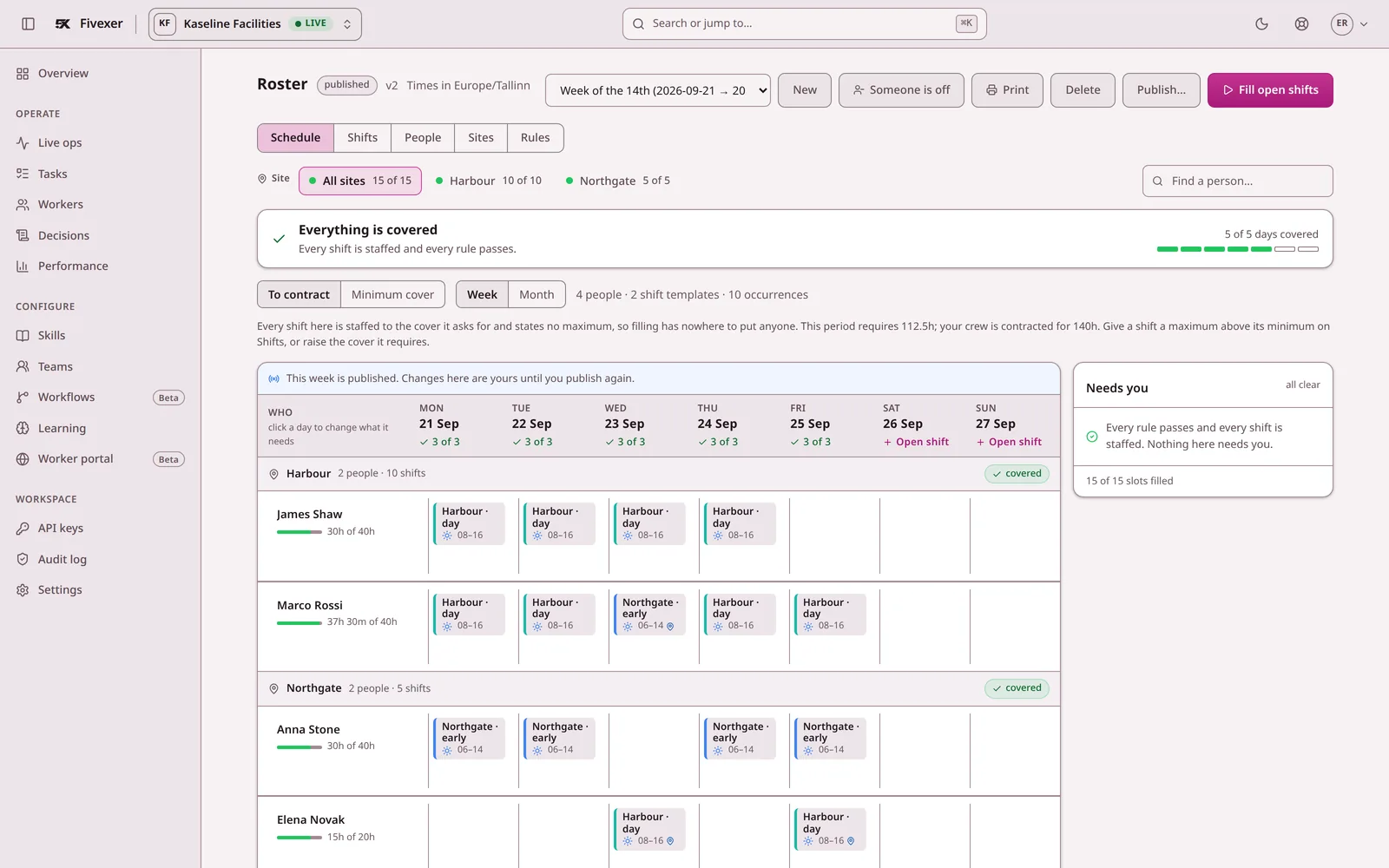
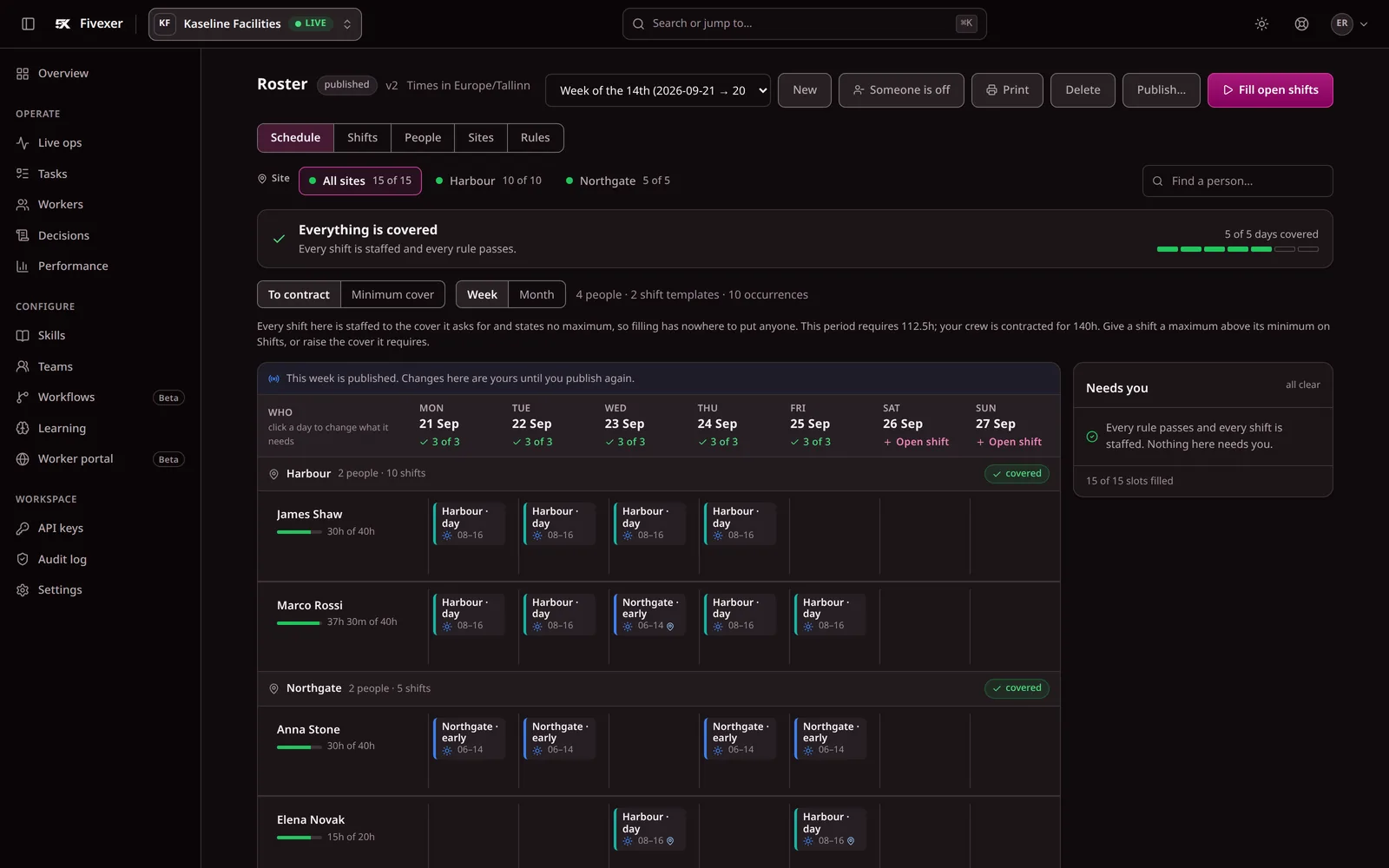
Check whether the replacement is available, qualified and permitted at the site. Inspect rest and existing assignments, then confirm how the change reaches the worker. Record what each product actually does in your trial, including any setup needed.
Use the shift-cover workflow as your test sheet. If you are also migrating a spreadsheet, follow the rota migration checks.
Heybegin also offers scheduling and shift-change workflows. Review the vendor’s own scheduling documentation alongside your trial.
Fivexer and Heybegin, question by question
Heybegin is scheduling and time tracking for restaurants, cafés and pubs. Fivexer builds the rota itself and explains each pick. The table shows where each one is stronger.
| The question | Heybegin | Fivexer |
|---|---|---|
| What does it cost at 60 workers?published list price, per month | €103 — Professional, billed annually; the page does not say what the price is per | €22.50 — 15 people free, then €0.50 each |
| Whose working-time rules are these?vendor defaults against figures you set | Not described on the published pages; overtime calculations are listed as coming soon | Yours only. Country packs are editable starting points, not rules applied automatically — a blank rule is not checked, and a configured one is enforced and explained in words. |
| Why him and not her?a record a worker or a works council can read | Scheduling with smart templates is published; a record of why a person was picked is not described | Every decision is one sentence: who took it, and who was ruled out by which rule. |
| Who covers Anna at 6am?into qualified, rested, permitted replacements | Shift swapping is published on every plan, Free included | Ranked replacements with the exclusions shown, scoped to the shifts the absence actually broke. |
| Can she work three sites this week?site permission and the journey between shifts | Free and Starter carry one location; unlimited locations start on Professional | Permitted sites are a hard boundary, and a stated journey holds the gap between two shifts open for it. |
| Who takes the job that arrives at 11am?live allocation once the roster is published | Not what the product sells — scheduling and time tracking are | The same engine allocates the ticket, job or case that arrives during the day, against who is on shift. |
| Can an AI agent use it directly?MCP tools, open source and API access | An API or MCP interface is not described on the pages read — one to ask them | Yes. Claude, ChatGPT, Cursor or any MCP client can inspect and operate the workspace through documented tools — the same rules and decision record as the UI. The engine and MCP server are open source. |
| Does it track hours and feed payroll?payroll-ready records against a clock-in kiosk | Yes — time tracking from Starter, a Smart Kiosk and PIN clock-in, with export reports on Professional | Worked hours become a reviewable payroll report with premiums, corrections, payroll IDs, period close and CSV export. It is not a GPS clock or a payroll processor. |
The vendor column states what that vendor publishes on its own pricing and feature pages, read on 28 September 2026. Where a product does more than its published pages say, that is theirs to say — every unfilled row above is a question you can put to them, and they are gathered further down this page. Prices are list prices in each vendor’s own published currency and are not converted; negotiated discounts are not modelled.
What each one costs as the team grows
Published list prices, read on 28 September 2026, in each vendor’s own currency and not converted. Heybegin bills for a monthly plan fee, and does not publish what that fee is per; Fivexer’s first 15 people are free, and each one after is €0.50 a month.
| How it is priced | 30 workers | 60 workers | 120 workers |
|---|---|---|---|
| HeybeginProfessional at €103 a month billed annually, €129 billed monthly — the lower figure is used. It is the first tier with more than one location. The page does not say what the price is per. | €103/mo | €103/mo | €103/mo |
| FivexerFirst 15 people free, then €0.50 a person a month. Rostering is never a paid extra. | €7.50/moPay as you go | €22.50/moPay as you go | €52.50/moPay as you go |
A single-location team could sit on Starter, €39 annually or €49 monthly. The headcount basis is unpublished, so these figures may not hold as the team grows. Organization, at €399, is not modelled. Prices are in euros, as published. Plans are sold on matched tasks. A 120-person rota is about 2,600 shifts a month, inside the free 10,000, so for a rota the per-person price is the whole bill.
What to ask Heybegin
Heybegin’s pricing page lists four tiers and never says what a price covers. Ask these before comparing a single figure.
- What is the monthly price per — the company, each location, or each employee?
- What counts as a “position”, and what happens when we need more than the plan allows?
- Does the price change as our headcount grows?
- Can the schedule be generated for us under our rest and hours rules, or is it built from templates?
- When do overtime calculations and availability approvals ship?
- Where is our data hosted, and which subprocessors reach it?
We have not answered these for you on purpose. A product’s capabilities and its data posture both change without notice, and the only reliable version is the one the vendor puts in writing for you.
Choose Fivexer — unless you want a kiosk by the door
For a restaurant group that plans shifts across sites, Fivexer is the stronger choice. The engine builds the rota under the rules you configure. Overtime and availability work today. A sick call becomes a ranked list of people who may cover. Every site is on every plan, the free one included. Choose Heybegin instead if a clock-in kiosk by the door and a native app from the app store matter most. Heybegin is shaped for restaurants from the start.
What this page will not claim
It does
- Build the rota automatically, checking the working-time rules you configure
- Turn one sick call into a ranked list of people who may cover
- Track overtime and availability today
- Record worked time on every plan, the free one included
- Let an AI agent operate the workspace through MCP tools
It does not
- Run a clock-in kiosk or ship a native app-store app
- Calculate tax or pay anybody
- Apply legal limits automatically — country packs are editable starting points and a blank rule is not checked
Not for you if
- You want a clock-in kiosk by the door
- Your crew expects an app from the app store
- One café, one location, and the rota never changes
Questions we get asked first
Is Fivexer cheaper than Heybegin?
It depends on what Heybegin’s price is per, and its pricing page does not say. Professional is published at €103 a month billed annually, €129 monthly. Fivexer’s first 15 people are free, then €0.50 each a month — €22.50 at 60 people.
Does Fivexer have a clock-in kiosk?
No. Workers record time in the worker app, in a browser, signed in with a PIN. There is no wall-mounted kiosk and no app-store app. If a kiosk by the door is the requirement, Heybegin is the better fit.
Can Fivexer build our rota automatically?
Yes. Set the shifts and the rules, then fill the gaps or solve the whole week. The engine checks the rules you configure and says why each person was picked. You approve the result before anyone sees it.
We run several restaurants. Does that cost more?
No. Every plan, the free one included, covers any number of sites. You pay by the person: 15 free, then €0.50 each a month. Each person can be limited to the sites they may work at.